AI-Empowered Product Operations
First published on LinkedIn, January 9, 2026
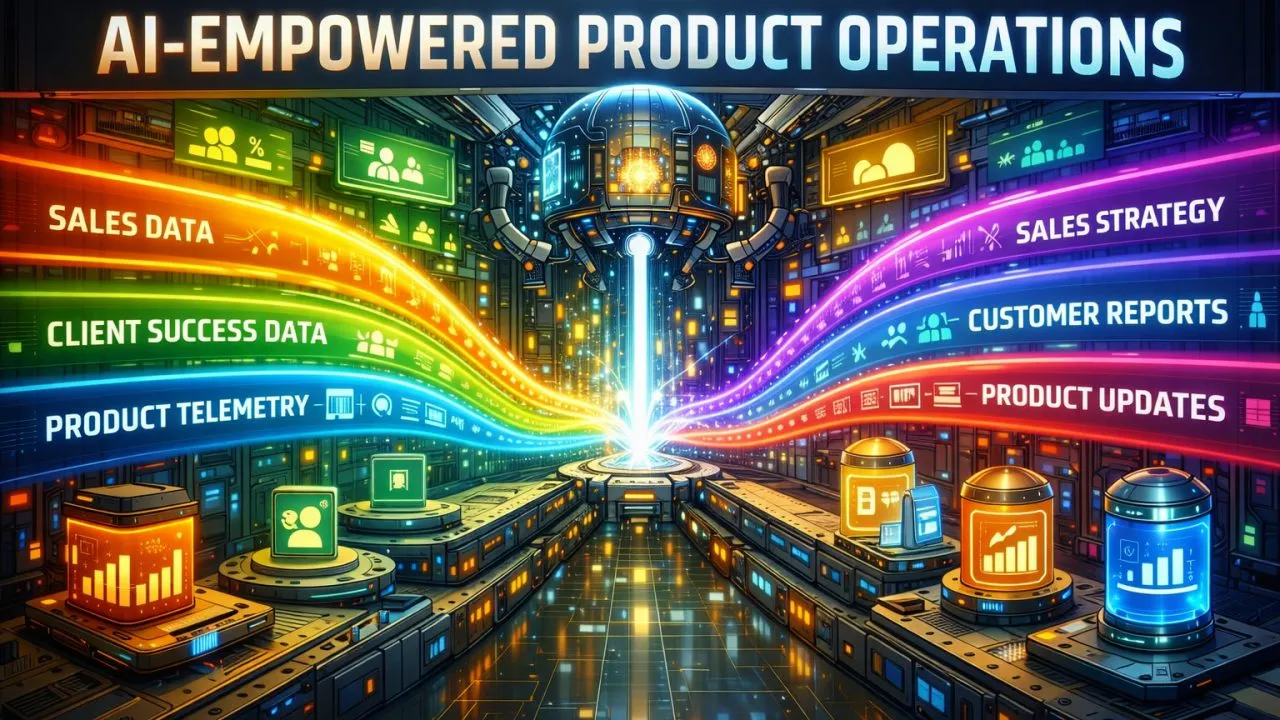
From Managing Products to Designing the Product Operating System
Over the last decade, I transitioned from a product individual contributor to product leadership. As I sought to figure out what that meant, one book that strongly shaped how I think about that shift is High Output Management. Its core idea is simple but profound: a leader’s responsibility is no longer their own output, but the output of their team.
In product organizations, that output is not features shipped. It is customer outcomes and business results. As my team scaled from three people to more than twenty-five product professionals and from 6 to 100+ technology professionals, it became clear that individual excellence was not enough. We needed systems that consistently reinforced the right behaviors: deep customer focus, evidence-informed decision-making, and awareness of how local product decisions impact the broader business.
This required a product operations competency.
Product Operations as a Leadership Responsibility
The most effective framing of Product Ops that I have seen is in Product Operations by Melissa Perri and Denise Tilles. They describe Product Ops as a discipline built around three pillars:
- Business and Data Insights
- Customer and Market Insights
- Processes and Practices
Each pillar has its own maturity curve, and organizations develop them unevenly over time. These capabilities rarely emerge organically at scale. They require intentional design, sustained investment, and leadership ownership. Here’s a recent post from Melissa that explains it more.
In practice, this responsibility often sits with product leadership. If you are accountable for outcomes, you are also accountable for the operating system that produces them.
Building the System Before AI
Inspired by Teresa Torres’ book Continuous Discovery Habits, I started by strengthening how we captured and shared customer insights. I built an interview snapshot library in Coda that allowed any member of the product team to log learnings from customer conversations, comment on emerging themes, and continuously refine our understanding of customer problems.
Through strong partnerships with our sales ops team, we also established a steady flow of competitive intelligence from the field. That signal was captured alongside customer insights rather than living in disconnected notes or slide decks.
To complement qualitative insights, I focused on improving our quantitative understanding of customers. I created a synchronization mechanism to pull CRM data into Coda and layered on segmentation views by demographics, product mix, and other attributes. This allowed teams to quickly answer questions like which customers fit a specific profile and then connect with those customers directly for discovery and validation efforts.
One of the most impactful and valuable capabilities has been linking records to customers across multiple docs. The customer dataset used for analysis became the same dataset used for operational workflows. Upgrade tracking, integration inventories, discovery questionnaires, and more all referenced the same live customer records.
What would traditionally exist as a fragmented set of spreadsheets, Confluence pages, etc. owned by half-a-dozen different teams became a shared, evolving 360-degree view of the customer, being fed with ongoing insights from multiple sources.
None of this involved AI. It worked, but it required significant manual effort. I spent many evenings cleaning data, matching records, and writing scripts. That investment delivered real value, but it also revealed a constraint. The system scaled only because someone was continuously pushing it forward, and while I believe it’s critical to provide these types of tools and resources, it also required more of my attention than it should have.
Rethinking the Product Operating System With AI
Today, the constraints and friction are rapidly disappearing. As I spend more time building applications in Claude, working with MCPs, and composing systems across tools, it is clear that the product operating system itself is ready for reinvention.
Customer insights can now be synthesized, summarized, and made searchable in near real time. Notes, transcripts, and artifacts can be connected automatically to customers, segments, and product areas. Integrations between tools like Coda, Jira, and CRM systems can be streamlined rather than stitched together manually.
At an organizational level, this unlocks new capabilities. We can more seamlessly summarize customer and market learnings across teams. Custom GPTs can act as intelligent assistants grounded in actual customer data, product context, and delivery signals. Teams spend less time curating information and more time acting on it.
This article itself was drafted locally in markdown, synced into Coda via an MCP server for tracking, (admittedly) polished in ChatGPT, and then published to LinkedIn. That workflow is not essential, but it illustrates a broader point. Composable systems give leaders more options as new use cases emerge and knowing how to compose those systems is becoming an essential skill. See my previous post.
A Concrete Example
In my previous post, I mentioned I would be sharing a few use cases with Coda. I’ve quickly thrown together a few tools (that you can copy and make your own) to get started.
To make this tangible, I created a synthetic customer dataset using ChatGPT and organized it into a simple Customer Insights Hub (you can copy this to get started or come up with your own). From there, I built a lightweight Continuous Interview Snapshot library and linked it directly to the customer list using Coda’s Cross-doc capability (read more here). I also used the sync page functionality to embed a view of the accounts to help with targeting customers for potential interviews and site visits.
Rather than duplicating customer context in every note (or avoiding having much if any of that context due to the effort), interview snapshots here reference a live customer record. Relevant attributes stay up to date automatically, and insights are immediately connected back to the broader system. The value is not the dashboard. The value is a shared, current understanding of customers that compounds over time.
As a supplemental experiment, I created a local notes repository, had Claude process it, and pushed structured insights into the interview tracker via the Coda MCP. With minimal tuning, this creates a path for busy team members to contribute insights quickly. Knowledge flows into the system with less friction and becomes accessible to the entire organization. It’s currently running at a C-minus level, but the potential is there.
Leadership Takeaways
Product Operations has always been about leadership leverage through systems. AI does not replace the responsibility to design and steward those systems. It amplifies it. Systems do not replace people, judgment, or storytelling; they create the conditions for better, more evidence-informed decisions at scale. The product operating system is no longer a static collection of tools. It is becoming a dynamic, evolving capability that shapes how organizations align, decide, and execute.
The true goal of Product Operations is not simply to move faster. It is to build organizations that learn faster, decide better, and compound insight over time. That objective sits squarely at the center of product leadership and should be inseparable from how Product Managers and executives measure their impact.